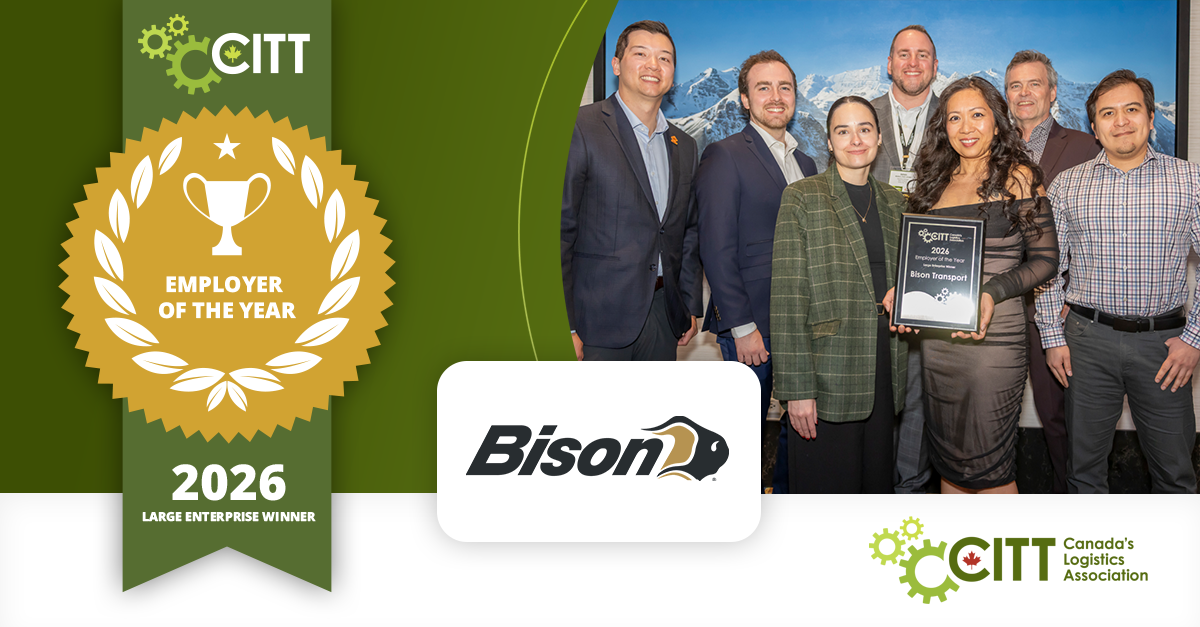
Bison Transport Named CITT’s 2026 Large Enterprise Employer of the Year
Bison Transport has been announced as CITT's 2025 Employer of the Year (Large Enterprise category)
CITT is proud to announce Bison Transport as the recipient of the 2026 Employer of the Year Award (large enterprise category). This distinction highlights Bison’s structured approach to training, formal systems of internal accountability, and a workplace culture that views professional development as a continuous process rather than a one-time event.
A Culture Driven by Care and Relatability
While many large logistics providers struggle to maintain cultural consistency as they scale, Bison Transport has integrated its core values, safety, spirit, service, sustainability, and success, into every level of its North American operations. Integrated are foundational beliefs to build strong relationships and empower their people.
According to Kristina Kircher, Bison’s Manager of Engagement & Learning, the baseline of their workplace culture is simple: when you join the business, you are genuinely cared for.
"There are so many caring people here that want to see you succeed," says Kircher. "And that’s really at the root of it... there are people here who are in your corner, want to help you out, and will 100% do that for you. If I was ever in a bind, there's no doubt that there would be someone here from Bison who would help me out."
Beyond the One-Time Training Event: "Bison U"
At the heart of Bison’s learning and development strategy is Bison U, a learning management hub housing well over 100 courses. The curriculum balances hard operational competencies, such as technical training for customs, logistics, dispatch, maintenance, and customer service, with personal development tracks covering burnout, mental health, mindfulness, and inclusivity.
Crucially, Bison's approach rejects the typical "set-and-forget" model of corporate training. Curriculum delivery regularly utilizes pre-work assignments and post-training tools.
"A lot of our courses have pre-work that people are required to complete, we want them to do a little bit of homework to prep," Kircher explains. "And we always have some sort of post-training resource for people to use as well, recognizing that you don’t remember everything that you hear. I am less concerned whether people can recall information and more concerned about actual learning taking place."
Closing the Loop with Leadership Accountability
What sets Bison Transport apart in the industry is how they track the real-world application of skills. Rather than assuming a training day is the end of the conversation, the Learning and Development team runs dedicated accountability sessions with company leaders to measure real progress.
"We encourage people to think beyond training day," says Kircher. "I hold a lot of accountability sessions with leaders where we talk about their commitments, 'You made a commitment two months ago, I want to know how it’s going. How have you implemented these skills? What benefits have you seen with your team?' It isn’t just a one-time learning event; it’s a whole progression of learning experiences that never really end."
This progression is reinforced at twice-monthly global management meetings, where training initiatives are consistently aligned with business execution. This includes keeping programs highly modern, such as introducing "AI Minutes" into management structures so leaders can routinely rotate and share practical efficiency gains from emerging technology.
Nurturing and Retaining Cross-Department Talent
Bison’s talent management approach recognizes that a career path isn’t always linear. Part of the annual review process for Canadian staff involves a co-produced development plan with managers that blends formal coursework with "stretch assignments" and cross-department collaboration.
This creates a high degree of talent mobility within the business. If an employee discovers a passion or skillset that aligns with a completely different sector of the enterprise, such as transitioning from frontline logistics into technical or department support roles, Bison actively supports the move.
"We recognize there's such a diverse skill set out there, and it would still be a win for the business if someone moved from one department to another," Kircher notes. "A leader is willing to support lateral moves if you have a passion and a skill set that better suits this other area, because we know it’s going to benefit the business, and everyone will be successful overall rather than losing you completely."
CITT extends its sincere congratulations to the entire team at Bison Transport for demonstrating how deep investment in relationships and rigorous training accountability builds an award-winning workplace.