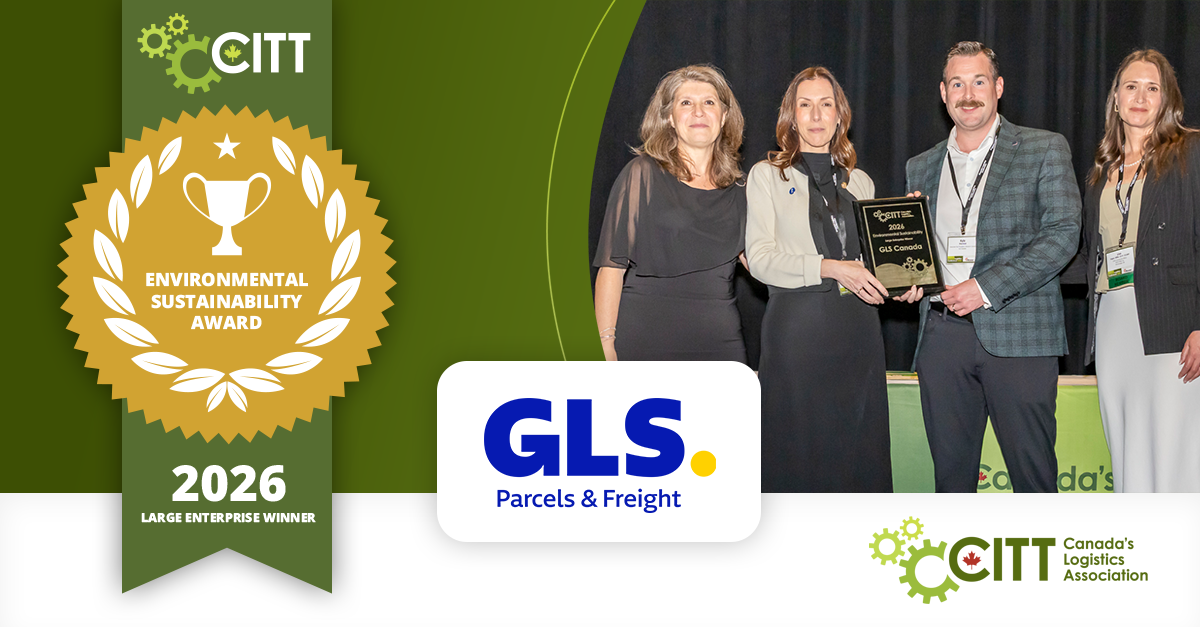
GLS Canada Honored with CITT’s 2026 Large Enterprise Environmental Sustainability Award
CITT has announced that GLS Canada has won its 2026 Environmental Sustainability award (large enterprise category)
CITT is pleased to announce GLS Canada as the recipient of the 2026 Environmental Sustainability Award for Large Enterprise. The accolade celebrates the company’s enthusiastic approach to fleet decarbonization and its commitment to verified, science-backed environmental benchmarks.
While establishing an actionable ESG framework remains a challenging obstacle in a volatile transportation market, GLS Canada has successfully combined corporate accountability with immediate commercial viability. Benefiting from over a decade of European expertise in fleet electrification, digital route optimization, and sustainable facility management, GLS Canada has been able to rapidly scale its domestic climate initiatives.
The 2030 Science-Based Targets
As a subsidiary of GLS B.V., GLS Canada is included in the Group’s commitment to the Science Based Targets initiative (SBTi), aligning its strategy with the climate goals of the Paris Agreement. Moving beyond broad environmental claims, the company focused on measurable, science-based action. Using 2021 as a baseline, the company is working toward approved SBTi targets for 2030, which include a 42% cut in Scope 1 and 2 emissions and strict reduction targets for its transport fleet1 all steering the company toward net-zero2 by 2045.
Achieving these targets requires a focus on both GLS Canada’s asset-based company fleet and its network of independent contract drivers.
Lowering Barriers for Scope 3 Partners
Recognizing that total decarbonization is impossible without bringing independent contractors into the fold, GLS Canada strategically installed commercial charging infrastructure directly on-site at its facilities. By ensuring that reliable charging points are accessible directly at corporate depots, the carrier has systematically reduced the financial barrier that prevents smaller owner-operators from transitioning to electric vehicles.
Driving an Optimized, Multi-Technology Fleet
On the corporate fleet side, GLS Canada’s deployment strategy relies on matching the appropriate technology to the operational requirement.
This balanced framework includes:
- Targeted Electrification: GLS initiated its EV journey with Lion 6 electric trucks deployed across operations in Quebec and British Columbia. This was followed by the procurement of Class 8 Freightliner eCascadias. To eliminate driver fears about rang, GLS intentionally keeps these assets restricted to local pickup and delivery routes.
- Electric Yard Operations: The carrier has optimized terminal efficiency by introducing heavy-duty electric shunting trucks into yard operations. Because these vehicles operate 24/7 in a contained, local area right beside depot charging hubs, they provide an ideal, continuous return on investment without range limitations.
- Drop-In Renewable Fuels: To bypass expensive capital expenditure and engine modifications on existing lanes, GLS Canada initiated a pilot program utilizing R99 renewable diesel during peak summer months. Acting as a lower-carbon alternative to traditional fossil diesel, renewable diesel serves as a direct drop-in replacement fuel that allows for emission reduction. Additionally, the carrier has integrated Compressed Natural Gas units that are fully compatible with Renewable Natural Gas without requiring vehicle modifications.
Data-Driven Progress through Telematics
To achieve the SBTi-approved goals of reducing emissions by 2030 and reaching net-zero2 by 2045, GLS Canada utilizes comprehensive Geotab telematics data. By analyzing total distance traveled, routing and fuel consumption across its network, the company is able to effectively calculate its GHG emissions and track year-over-year progress.
For other logistics enterprises eyeing the starting line of their own climate journeys, GLS Canada’s operational philosophy remains clear: do not wait for the "perfect" future asset. Start executing, learning from the infrastructure, and collecting the data today.
1 Scope 3 fleet targets include a 36.9% reduction in emissions per kilometer-tonne for light commercial vehicles and a 31.7% reduction for heavy freight trucks.
2 GLS B.V. is committed to reduce its absolute Scope 1, 2 and 3 greenhouse gas emissions by 90% by 2045, using 2021 as the base year. The residual emissions will be neutralized. This means the business counterbalances up to 10% of its CO2e emissions with investments in carbon removal projects outside its value chain, in line with the SBTi Net-Zero Standard. The Science Based Targets initiative commitment of GLS B.V. encompasses all affiliated companies of GLS B.V. operating under the GLS trademark.